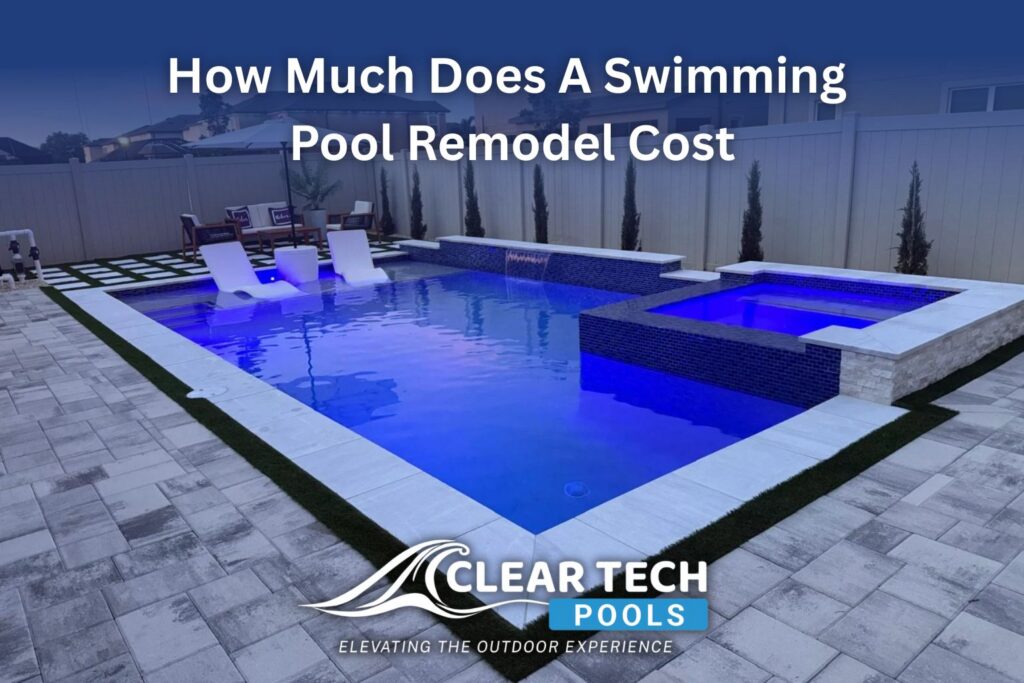


How Often Should You Clean Your Pool to Maintain a Perfect Backyard Oasis?
At Clear Tech Pools, we know that the key to a stress-free summer is establishing a consistent cleaning frequency. For beginners, pool care doesn’t have to be a mystery; it only requires you to read this dynamic guide, where we will tell you the fundamental 5-step process for cleaning, including the 7-step process that we use to maintain an enviable pool.
| Step | Task | Frequency |
|---|---|---|
| 1 | Skim surface debris | Daily |
| 2 | Brush walls and steps | Weekly |
| 3 | Vacuum pool floor | Weekly |
| 4 | Clean skimmer and pump baskets | 2x per week |
| 5 | Test water chemistry | Weekly |
| 6 | Balance pH and alkalinity | Weekly |
| 7 | Shock the pool | Weekly or after rain |
Most pool owners in the St. Petersburg and Tampa area start out the same way, excited about their backyard oasis, then quietly overwhelmed the first time the water turns cloudy. It doesn’t have to go that way.
The truth is, a clean and safe pool isn’t about spending hours every weekend. It’s about knowing the right things to do and doing them consistently.
This guide walks you through exactly that: the 5-step process for pool services and the straightforward changes that make maintenance manageable, even if you’ve never owned a pool before.
I’m Ryan Lesperance, founder of Clear Tech Pools, and I’ve spent years working hands-on with homeowners across the Tampa Bay area to simplify the professional pool-care processes we use, explain them for beginners, and cut through the confusion, so you can actually enjoy your pool instead of stressing over it.
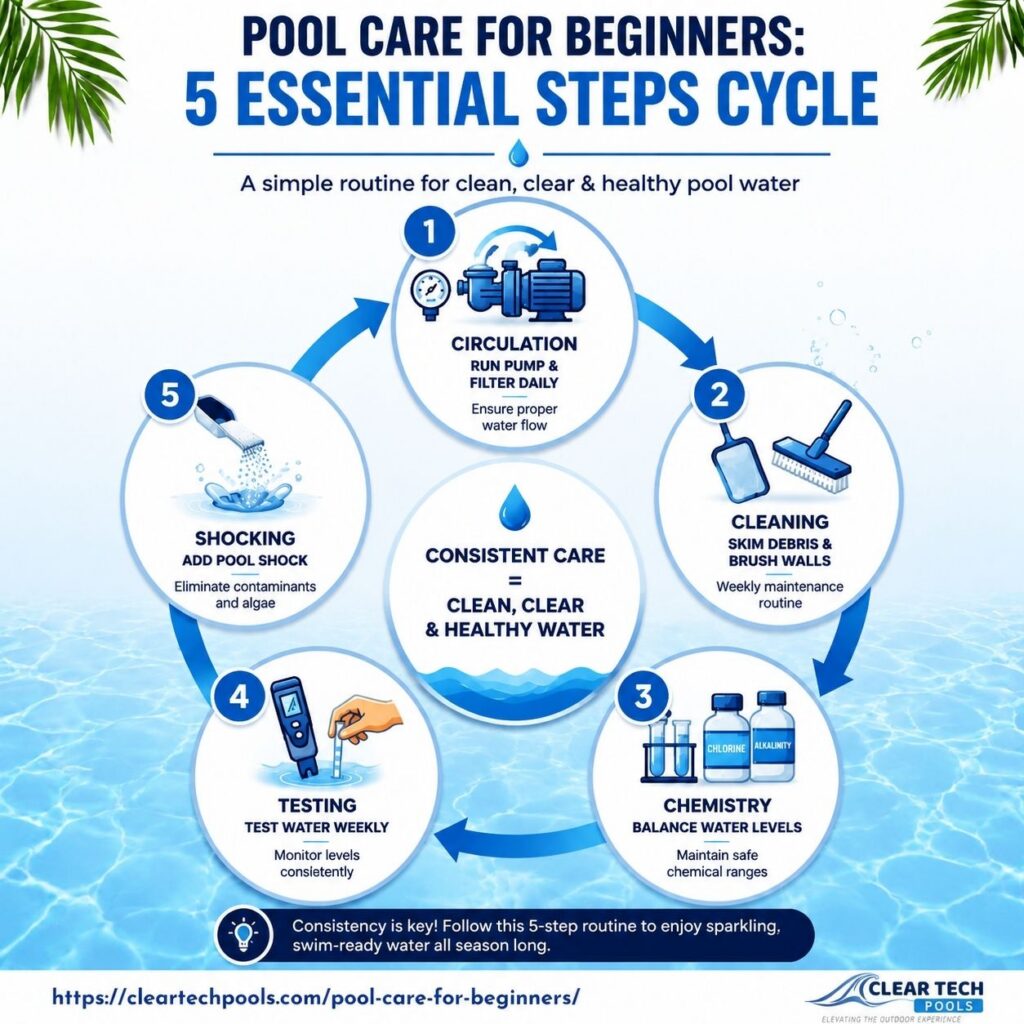
Basic pool care for beginners glossary:
The Fundamentals of Pool Care for Beginners
How do you transform a complex system of pipes and chemicals into a stress-free sanctuary? At Clear Tech Pools, we believe the first step is understanding that a healthy pool relies on a regular cleaning frequency and knowing your pool’s volume. Every chemical dose and pump runtime depends on one critical number: your pool’s volume.
Essential Equipment and Volume Math for Pool Care for Beginners
To get started, you’ll need a few non-negotiable tools: a telescopic pole, a skimmer net, a pool brush, a vacuum head with a hose, and a reliable water testing kit. Once you have your gear, you need to “know your number.”
Calculating pool volume isn’t just for math enthusiasts; it’s how you avoid wasting money on chemicals. For a standard rectangular pool, use this formula: Length x Width x Average Depth x 7.5 = Total Gallons.
- Average Depth: To find this, add the shallow end depth to the deep end depth and divide by two.
- Round Pools: Use 3.14 x Radius squared x Average Depth x 7.5.
- Complex Shapes: For pools with dramatic drop-offs, treat them as two separate sections (shallow and deep) and add the volumes together.
Knowing your volume allows you to follow the “1 pound per 10,000 gallons” rule often found on chemical labels, ensuring you never over-treat your water.
Mastering the Three C’s of Pool Care for Beginners
We like to use the “Three C‘s” framework to keep things simple: Circulation, Cleaning, and Chemistry. Think of your pool like a human body. The pump is the heart, constantly pushing water to prevent stagnation. The filter is the liver, removing the “waste” (like dirt and oils) to keep the system pure. Finally, the skimmers and returns act as the veins and arteries, ensuring the “blood” reaches every corner.
According to A Beginner’s Guide to Pool Maintenance, proper circulation is the single best way to prevent algae. If the water is moving, it’s much harder for bacteria to take root.
| Filter Type | What it Filters | Maintenance Method |
|---|---|---|
| Sand | 20-40 microns | Backwashing (reversing flow) |
| Cartridge | 10-15 microns | Rinsing the polyester filters |
| D.E. (Diatomaceous Earth) | 2-5 microns | Backwashing and adding new D.E. powder |
5 Quick Changes for a Pristine Pool
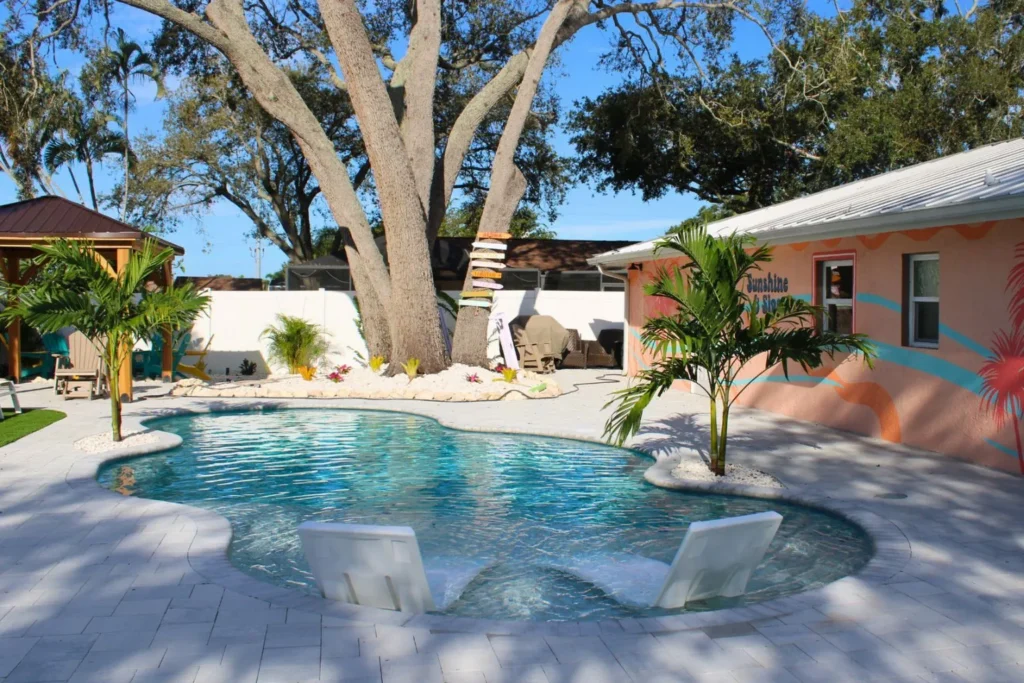
1. Optimize Your Circulation and Filtration System
One of the most effective changes you can make is upgrading to a variable-speed pump. In our Florida climate, from Sarasota to Spring Hill, pools run year-round. While a single-speed pump is either “on” or “off,” a variable-speed pump can run at lower speeds for longer periods, often saving homeowners up to 40% on electricity costs.
Pro Tip: Angle your return jets (the “eyeballs” where water enters the pool) downward and in a circular pattern. This eliminates “dead spots” behind ladders or in corners where algae loves to hide.
2. Implement our 7-step process for pool services
Consistency is the secret sauce. Follow this 7-step process for pool services used by our pros at Clear Tech Pools to keep your water crystal clear:
- Skim surface debris daily: Removing leaves before they sink prevents organic stains.
- Brush walls and steps weekly: Use a brush compatible with your surface (nylon for vinyl/fiberglass, stainless steel for concrete/plaster).
- Vacuum the pool floor: Use slow, overlapping strokes to ensure you catch every pebble and bit of sand.
- Clean skimmer and pump baskets: Clogged baskets put unnecessary strain on your pump’s seals.
- Test water chemistry levels: Use a liquid DPD kit for the most accurate readings.
- Balance pH and alkalinity: Always adjust your Total Alkalinity first, as it acts as a “buffer” for your pH.
- Shock the water at night: This is a game-changer. Sunlight’s UV rays degrade chlorine rapidly. Shocking at night ensures the chemical has 8-10 hours to work at full strength.
3. Perfecting Your Water Chemistry Balance
Maintaining the “sweet spot” in your water chemistry prevents skin irritation and protects your pool’s interior. These are the ideal ranges for May 2026:
- pH: 7.4 to 7.6 (matches human eyes for comfort).
- Total Alkalinity: 80 to 150 ppm.
- Free Chlorine: 1 to 3 ppm.
- Calcium Hardness: 200 to 400 ppm (prevents plaster erosion).
- Cyanuric Acid (Stabilizer): 30 to 50 ppm. Think of this as “sunscreen” for your chlorine.
4. Monitor the “Check Engine Light” (Filter Pressure)
Your filter’s pressure gauge is your best friend. When you clean or backwash your filter, note the “baseline” pressure. Once the PSI (pounds per square inch) rises 8 to 10 units above that baseline, it’s time to clean it again. Ignoring this leads to poor circulation and, eventually, cloudy water.
5. Be “Storm-Ready” with Proactive Shocking
Living in Tampa Bay means dealing with heavy afternoon rain. Rainwater isn’t just water; it brings nitrogen and organic matter that “eat” your chlorine. A quick change to your routine: if a heavy storm hits, shock your pool immediately after. Don’t wait for your weekly scheduled day, or you might wake up to a green swamp.
Troubleshooting and Professional Care
Even with the best pool care for beginners routine, things can go sideways. If your water looks cloudy, check your filtration first. Often, it’s a sign the pump isn’t running long enough (aim for 8-12 hours daily) or the filter media is exhausted.
When to call Clear Tech Pools:
- High Filter Pressure: If you’ve cleaned the filter and the PSI stays high, you may have a deeper clog or equipment failure.
- Persistent Algae: If you’ve shocked the pool twice and it’s still green, you likely have high phosphate levels or a stabilizer imbalance.
- Vacation Prep: If you’re heading out of town, we can provide temporary maintenance so you don’t return to a science project.
Whether you are a DIY enthusiast or prefer a “hands-off” approach, your pool is a major investment. In St. Petersburg and the surrounding Pinellas County area, we’ve seen how proper care can extend the life of a pool finish by a decade.
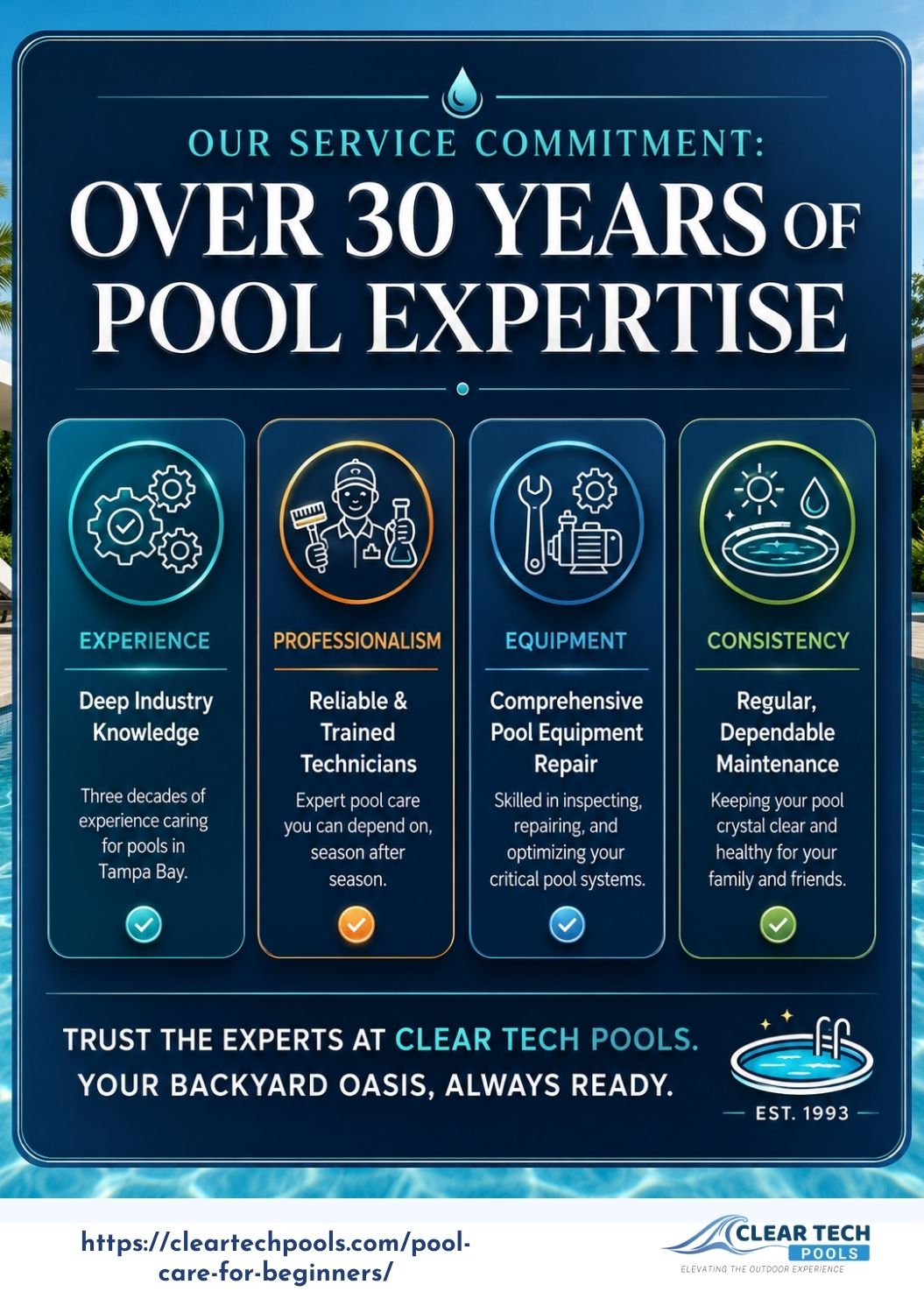
Ready to take the stress out of your backyard? For More info about Tampa pool maintenance, or to schedule a professional equipment inspection, reach out to us. With over 30 years of experience, we’re here to ensure your only job is to enjoy the water.
Common Beginner Mistakes to Avoid
- Eyeballing Chemicals: Always measure. Adding too much “pH Down” can make your water acidic enough to eat through copper heat exchangers.
- Ignoring the Water Level: If the water drops below the skimmer opening, the pump will suck in air, which can melt the pump basket or damage the motor.
- Brushing Only the Floor: Algae loves the “dead zones” on steps and behind ladders. Brush the entire surface!
Clear Tech Pools serves homeowners across St. Petersburg, Tampa, Lutz, Seffner, and the entire Tampa Bay region. We are your partners in protection, ensuring your “outdoor oasis” stays pristine for years to come.
Recent Articles

How to Handle Your Pool After a Major Storm?
By Ryan Lesperance |

How to Choose the Best Pool Vacuum Cleaners: Expert Reviews & Buying Guide
By Ryan Lesperance |